
How to calculate a car loan payment
A new car, or new to you (used car), is exciting. But a car loan payment? Not so much.
If you are financing a car loan through the dealership, be alert and be ready. The finance departments are more about sales than anything else. At this point, you may be exhausted and think the game of negotiating is over because you agreed on a price. It's not. Don't be naïve.
Mathematical mistakes are highly unlikely in the finance department. If they are wrong, it's usually in the dealer's favor. Funny how that works. So be alert and beware.
[the_ad_placement id="manual-placement"]
In my experience, I have seen mathematical mistakes (I am highly suspicious the dealership is trying to lie and it's not really a mistake) that result in higher payments and higher than advertised rates.
It's an easy fix to make sure your car loan payment is correct. Arm yourself with a financial calculator and work out the math yourself. It could save you thousands.
How to calculate a car loan using the 10bii financial calculator
Full Transcript [Edited for readability]
In this video, I'm going to show you how to calculate the interest on your car loan and figure out the car payment to make sure that you're not overpaying. If this is your first time at a channel or you haven't subscribed. Click on the subscribe button at the bottom. My name is Travis Sickle, CERTIFIED FINANCIAL PLANNER, with Sickle Hunter Financial Advisors.
I bought my car about two months ago, and I could not believe the number of games played.
When I went to go and finance the car, the interest payments and the interest rates did not line up. Luckily, I had a tool and a little knowledge, and I want to give you that tool, and I want to share that knowledge. And I'm also going to show you a bonus tip that will make it so much easier.
So when you walk into the dealership, you're not going to get taken for a ride. So the parts of the loan that you need to be familiar with and the loan's timeframe. So is it a three-year, four-year, or five-year loan? We're dealing with the interest rate, how much we're paying on that loan, and the actual amount you are financing.
So it's probably not financing the whole car; you are probably financing only a portion of the car. So we want to look at that and the payments and get that thing paid off as quickly as possible. Those are the parts that we're going to talk about, and I'm going to go through them. And I'm also going to show you this great app you can download on your phone and bring with you to the dealership.
So you can look at the math on your terms. I will put a link in the description at the bottom to the actual calculator that I use. Now, if you use a variation of it, that's fine too. I don't collect a fee on it. There's no referral. It's not a referral link or anything like that. You can download it.
It may cost one or $2, maybe a little more, but it's a great tool, and it'll save you way more than a couple of dollars. So let's jump into it right now. So here is the financial calculator that I will walk you through. I'm going to give you this example. And let's say that you have a car loan that you will pay for over five years.
We're going to have an interest rate of 3%. We're going to finance $20,000. And I want to figure out what those payments are going to be. I wouldn't say I like the car dealership telling me what those payments are because their math sometimes gets fuzzy. And if you don't believe me, I will show you why. So let's take a look at this. So the first thing we need to do for this calculation is to take this payment and make sure that it says 12. That's 12 payments per year.
So it should say 12 payments per year equals 12. You do that by hitting one, two-shift, and then hitting this payment key right up there. And you can see that it brings 12 here and 12 up there. And if you made one payment, the same thing, you could see it says one versus one. So we want 12 payments because we're paying the loan monthly.
So we will start from the left and work our way to the right. So all these buttons up here are what we're looking at. So this looks more complicated than it is. So I'm going to walk you through it. So let's see if we have a five-year loan. So the first thing we're going to do is we're going to hit our five and then hit shift and then come up here and hit, "end," and you could see to 60 months that's going to be 60 months.
We want to put it in the interest rate. So what we need to do is hit three, then shift, and then the interest, and you can see that it says three. Now the present value PV, which is the amount that we're financing, will be $20,000. So hit 20,000, hit the PV, see 20,000 up there, and we want to figure out what the payment is.
So we'll hit zero for our future value because, at the end of the five years, the loan will be paid off; so if we tap on the PMT, we could see that it says 359.37. So that's what our payment is. It sounds negative because it's this payment is an outgoing transaction. So this will be our payment. So let's say that we get to this math and figure out that we cannot pay $359.
So we can look at whether we can either extend it past five years or put more down to get a lower payment, so let's put more down to get a lower payment. Well, if you already know what we can pay, what we could do is say, let's say it's $300 that we can pay.
We're paying it. So we're going to hit the negative key. Then if we click on the present value, we can see that it drops to 16,696. If we financed this amount at 3% for 60 months, then we'd have a payment of $300. Of course, that requires you to put more down upfront.
But this is how the math for calculating a car payment generally works. Now, let's say that we went to six years on that same loan, and we'll bring this back up to our $20,000. Then you can also see that it drops from our original amount to three, $304. So if you go back to the five years, we could see it was at $359. But if we extend it out further, it'll bring that payment down.
But that doesn't mean our total interest is going to be less. It just means that our payments are going to be less. And that's where the real gain comes in. So you want to make sure that the total amount you're paying is what you're comfortable with. So there's another way that we can take a look at this.
This screenshot is on my iPad, but you can do the same math right on your iPhone. I'm just using my iPhone to do the screen recording to show you how it works. So there's a more straightforward calculator. If we hit this purple button or this blue button right here and hit the worksheet, It'll bring down this little menu.
And the first one is are auto loans. Now, this is an excellent tool because we can look at the purchase price and, let's see, we bought the car for $30,000, or we're going to buy it for 30. You could put in all the fees or rebates, the trading values, and the down payments. We're just going to stick with the down payment because we're not going to have any other fees for this example.
But let's say that we put down $10,000, which would mean that we're financing 20,000. So if we come over here and look at the interest rate, put in our 3%, put in our five years for the duration of the loan, we could see that the loan amount was 20,000. Our total interest will be $1,562, bringing the total cost of ownership up to 30 15 62.
So if we spent all this time negotiating the price, and we decided that it would be $30,000, and the dealership agreed they're making more money. Now a side note, whether or not they make money or the finance company makes money; it doesn't matter. You're paying $31,562, So don't put any comments at the bottom saying Who's making money on the interest?
I don't care. All I care about is how much is coming out of your pocket. That's it. That's all. We're going to take a look at So that's all. That's it. That's all we're going to take a look at. So again, if we have 30,000, if you're sitting there and saying, wait a minute, I still can't pay this $359 per month, you can adjust those numbers right here.
Now, let's say that you want to put, you know, 11,000 down, and we hit this print button. We could figure out that our payment will drop to three 41. But let's say you still need it to come down further. You can either negotiate for it on the interest or the total price. So if they're willing to come down or if there's some way they can figure out how to get you a lower interest rate, let's say that's 2.5, and we hit print.
We can see that it comes down to three 37. So you can adjust these numbers in real-time right there at the dealership. So you know that they're not playing any games. Now, this isn't a video about negotiating the car. It's just about knowing the math behind it and how to calculate it. And don't be afraid to break out the financial calculator, and you can bring it to the dealership with you.
So when they quote you, you can say whether or not it's correct. And if you need to figure out how to adjust that math, you can do it yourself. And I hope this is helped. If you've enjoyed this video. Be sure to subscribe and leave your comments down at the bottom.
Download 10bii Financial Calculator App
The financial calculator for your iPhone can be found here. You can use any 10bii financial calculator but some work a little differently than others. The link below is the financial calculator that I have been using for years.
This is not an affiliate link, this calculator just works well. https://apple.co/2J5kWTQ
How to set up the 10bii calculator
1. Clear Out the Calculator
First, you need to clear out all the values and set the payments to 12 payments per year. While the interest is calculated daily, setting up our calculation for monthly will help us quickly see how much the monthly car payments will be. If you set up the calculator for 365 payments, that's okay, too, but you will have an extra step in calculating your monthly payments. TIP: The calculations will round since we are using monthly payments instead of the accurate calculation of daily interest. If the numbers are not exactly as shown, this is most likely why.
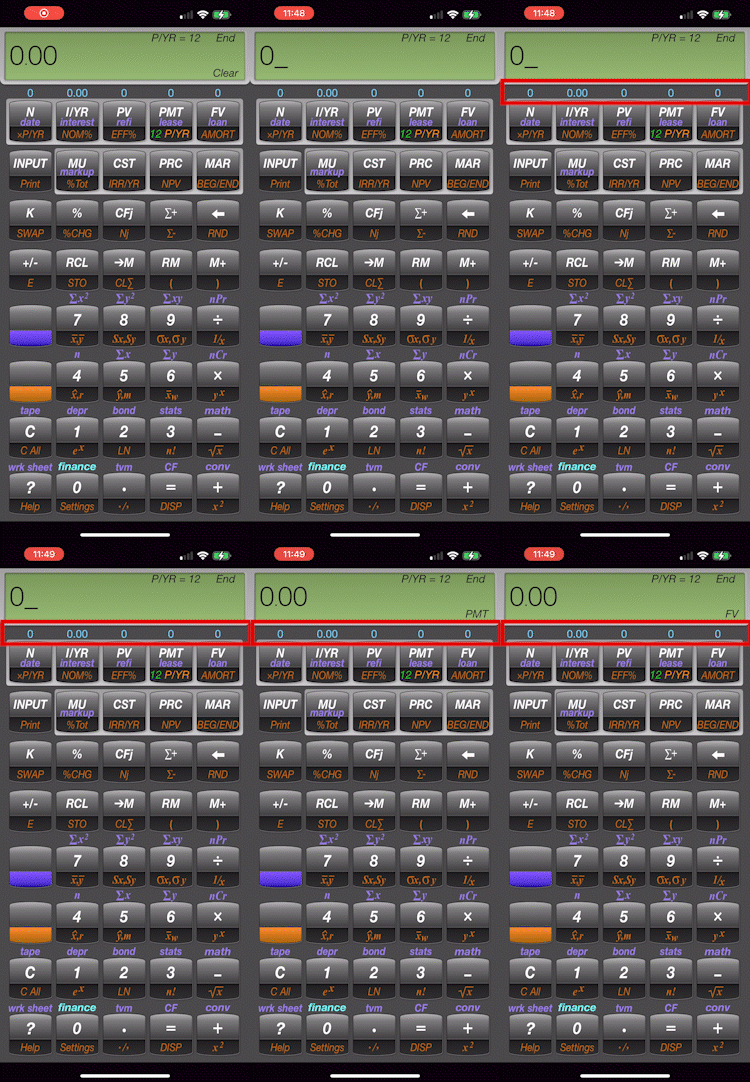 Press zero, then the "N," key.
Press zero, then the "I/YR," key.
Press zero, then the "PV," key.
Press zero, then the "PMT," key.
Press zero, then the "FV," key.
You should now see zero's across the top of the calculator.
2. Setup Payment Frequency
 Interest payments are calculated on a daily basis but since you're most likely to make monthly payments for your loan we will set up the calculator on monthly payments. The calculations will be very close but if you are off by a few pennies this is the reason and it's not an error.
Press 1, then 2 for 12 payments.
Press shift (orange button) then PMT
[the_ad_placement id="manual-placement"]
3. Setup the Number of Payments

The number of payments is the "N" button at the top. First, press the clear button marked "C" to clear out any numbers left on the screen. It probably already shows zeros but just in case, clear it out. Then enter the number of years you will make payments. Not the number of payments or the number of months. Because we previously entered the payments per year in step 2, you only need to enter the number of years. Once you do, you'll see the total number of payments right above the "N" key.
Enter the number of years.
Press the shift key (orange key).
Press the N key
Notice in this example, I am entering 5 years, so the number of payments is calculated as 5 years x 12 months = 60 total payments
4. Setup the Interest Rate
 The interest rate will be entered as an annual number; it's the Annual Percentage Rate (APR). Since we entered the number of payments per year already, we will not divide the APR to adjust for those payments.
The keystrokes are similar to entering the number of payments. We will enter the APR.
Enter the APR/interest rate.
Press the shift key (orange key)Press I/YR
5. Enter Loan Amount (PV, Present Value)
The loan amount is the balance at the beginning of your loan. If you buy a car for $30,000 and finance $20,000 then $20,000 is your loan amount.
Enter the loan amount.
Press the PV key.
Goto the next step.
6. Solve for Payment Amount (PMT)
In this calculation, we are figuring out how much the payment will be. Since we want to solve for payment then we will not enter anything for payments. Skip it.
[the_ad_placement id="manual-placement"]
7. Enter Future Value (FV)
The loan's future value in this calculation will be zero. If this is confusing, then think of the future value as your goal; to have this loan paid off. You want to have a future value of zero because you want this loan completely paid off after you have made all the payments.
Enter Zero.
Press the FV key.
Go to the next step.
7. Find out the payment amount
Last step, all you need to do is press the PMT button and it will display the payment. That's it. You can adjust each number to see how different rates or lengths of your loan will affect the monthly payment.